
This post is the complete first chapter of my book, Refactoring Experience: The Anatomy of Suffering and the Illusion of Self. I’m sharing it here as a self-contained introduction to the experiments and the framework.
Daily life comes with a set of stubborn intuitions:
“My lived experience is continuous and flowing. My feelings are certain and real. Every second, I am directly experiencing what is happening now. And through all of this, I am directing my thoughts and actions.”
It sounds airtight, doesn’t it?
Earlier, I promised that this book would attempt to take apart the structure of experience by hand—that was not a metaphor. In this chapter, we will run a few small experiments to test what feels “self-evident.”
Up close, that smooth surface may turn out to be cracked.
1.1 The Non-Flowing River
Experience is continuous… Is it?
Experiment A
Form a simple thought, such as “I want to drink water.”
Try to hold it. Repeat it quickly in your mind if you’d like to.
Eventually, it snaps. It drops out, often so abruptly that you only notice its absence after something else has already arrived.
In the instant it disappears, does it fade the way a sunset fades? Or is there simply no “in-between” to point to?
(If you catch yourself thinking about this when you’re half-asleep and the mind is messy, that’s an even better moment to watch how thoughts shift.)
Experiment B
If you clench your fist tightly, then release it, you can feel the faint tingling where fingers meet the palm. Now, rub your heel against the floor. Attend closely to the pressure and temperature at the point of contact.
Switch back and forth: Palm. Heel. Palm. Heel.
Don’t rush. Do it slowly.
Now, watch the switch itself. From palm to heel, do you notice any transition at all? Or is it simply: one moment is palm, the next moment is heel—nothing in between?
What this suggests
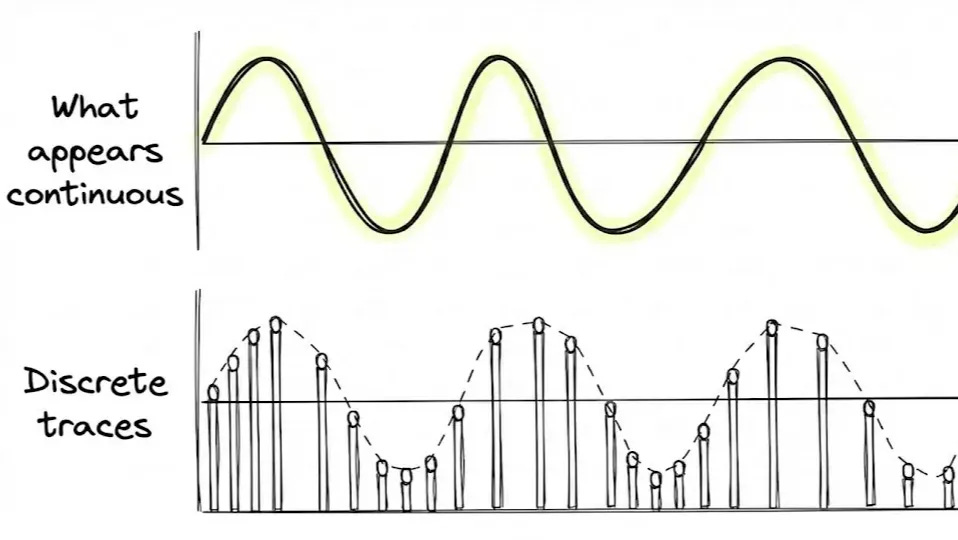
In memory, life experience seems continuous and flowing. But under close inspection in the present, the switch leaves no trace. Foreground content seems to update more like a slide deck than a river:
Snapshot A → [gap you can’t point to] → Snapshot B
This isn’t just a curious observation. The sense of continuity may be something stitched together afterward.
1.2 The Flattened Particles
When we say, “I am annoyed,” the feeling often presents as an indivisible chunk. But is it?
Experiment C
Bring to mind a mildly unpleasant event from recent days, perhaps a friction with a person or a situation. (There is no need to touch deep trauma; a small discomfort is sufficient for this purpose.)
Move slightly closer to the raw texture of the unpleasantness. Before naming it, step back and ask: What is the first thing that can be discerned?
A sudden tightening in the chest?
A constriction in the throat?
A faint stab at the temple?
A face or scene flashing in the mind?
An urge to stand up and leave?
Or a half-formed sentence: “He really is…?”
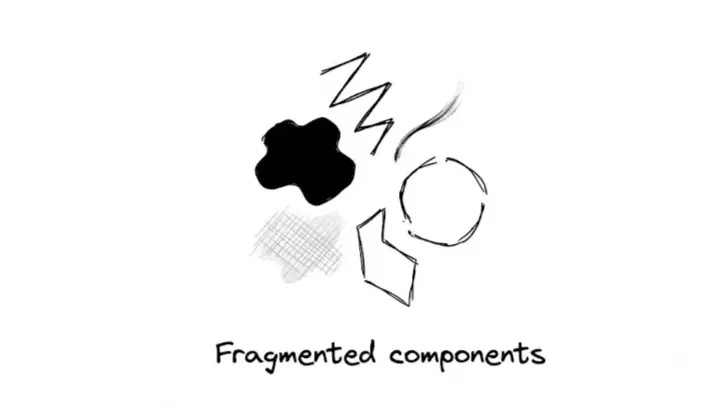
If you repeat this observation, you may notice something striking: what appeared to be a single feeling actually comes in very different textures—bodily signals, visual imagery, verbal thoughts, impulses. Sometimes, you can even detect a sequence: this first, then that.
These distinct bits fuse into a single lump, producing a subjective impression of a single coherent whole.
Language compresses it even further. Like a diner who gives the meal a one-star verdict without naming what went wrong, the mind often collapses the complexity of experience into a crude one-line remark:
“Anyway, I just feel bad.”
1.3 The Second-Hand Now
A moment ago, we glimpsed a fracture in the timeline: the “present” is not a pure tense.
Experiment D
Consider a common scenario: You send a message to someone you care about. Your phone remains silent.
Now, observe the reaction in slow motion as it rises.
Perhaps a memory flashes—a previous time you were brushed off. A thought appears: “Not again.” You might feel a faint shame, or a sudden contraction in the chest.
Notice that in this brief sequence, not everything is coming from the present.
The silence is a present fact. But the scene of being ignored is a past experience resurfacing on its own. The thought “Not again” points to history. And the shame is likely a groove worn smooth by repetition—triggered by the silence, but not strictly bound to it.
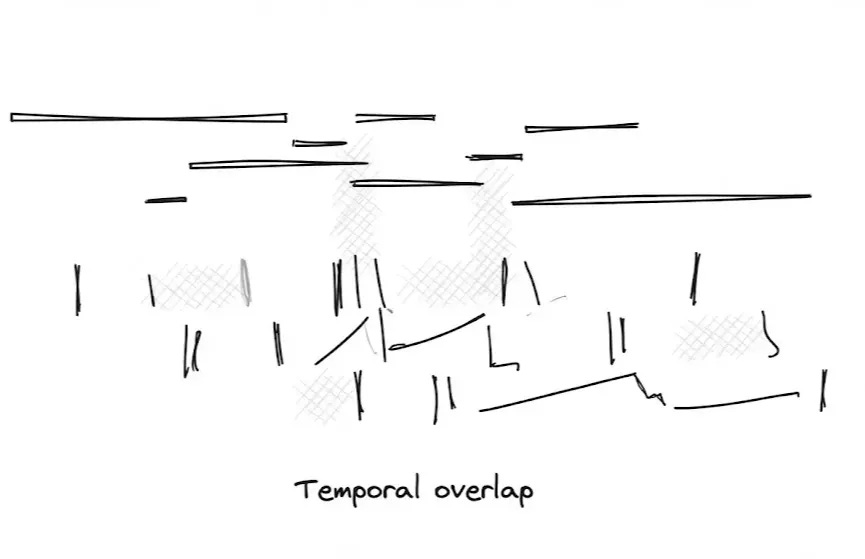
When these pieces are laid out, you may find that a substantial part of “what is happening” is actually arriving from earlier.
One might object: This is an imagined scenario, so of course it uses memory.
Then look at something physical—the cup beside you. You recognize it as a cup only because past experience participates in present vision. Without any contribution from memory, there would be no recognition of “cup”—only colors, edges, and shapes.
This applies to almost every moment of perception. The “now” is rarely a clean, isolated region. It is a superimposition: current input layered with historical input.
We believe we are living fully in the present, but much of the time, we are simply re-steeping the past in today’s water.
1.4 The Late Commentator
So far, we have exposed three cracks in the smooth surface of experience:
The sense of continuity breaks down (1.1).
The “wholeness” of feeling splits open (1.2).
The “present” is a superimposition of past and present (1.3).
Now, if experience is not inherently continuous, not inherently unified, and not strictly confined to the present—where does the unshakeable sense of unity come from? Why do we feel, so powerfully, that it is me who is living through all of this?
From birth, the body changes and memory keeps changing, yet we rarely doubt the certainty of “me.” On closer inspection, however, what we call “I” is not a solid object. It is a feeling: the sense that “there is a subject here, experiencing everything.”
Experiment E
In the next few seconds, you will naturally blink. Watch closely:
Before the blink happens, do you actually experience a command that announces “the blink is about to begin”? Can you notice that the action occurs first, and the confirmation—“I just blinked”—arrives afterward?
Of course, you can decide deliberately to blink. But even then, what appears first is not a clean internal order. It is a tendency taking shape—a subtle tension forming in the eyelids. The action is already unfolding. Only afterward does the mind add its running commentary: “I did that.”
This is hard to verify because it happens fast. So let’s stretch the timeline:
Have you ever been absorbed in a movie, or deep in conversation, or caught in the moment of reading—so absorbed that you “forgot yourself”?
In those moments, there is no running voice in the mind saying “I am watching” or “I am reading.” Even the feeling that “there is an I here” may be indiscernible for minutes at a time. The sense of subjectivity simply does not arise.
It looks as if a unified “I” is undergoing everything. But the sense of subjectivity is not a commander that is always present.
It is easy to understand why “I” disappears in deep sleep. But even while awake, the sense of subjectivity is not the origin of experience, nor the one directing it from the beginning. It is often a late commentator, arriving (only sometimes) after the fact, and tagging what already happened as “I did that.”
And that immediately opens a more basic question:
If the sense of subjectivity is not the starting point, then what is experience like before any ownership or commentary appears?
This might feel like a moment of vertigo, as if the frame rate just shifted. But we aren’t losing contact with reality. We are gaining resolution.
Clarity changes the physics of suffering.
Where to go next
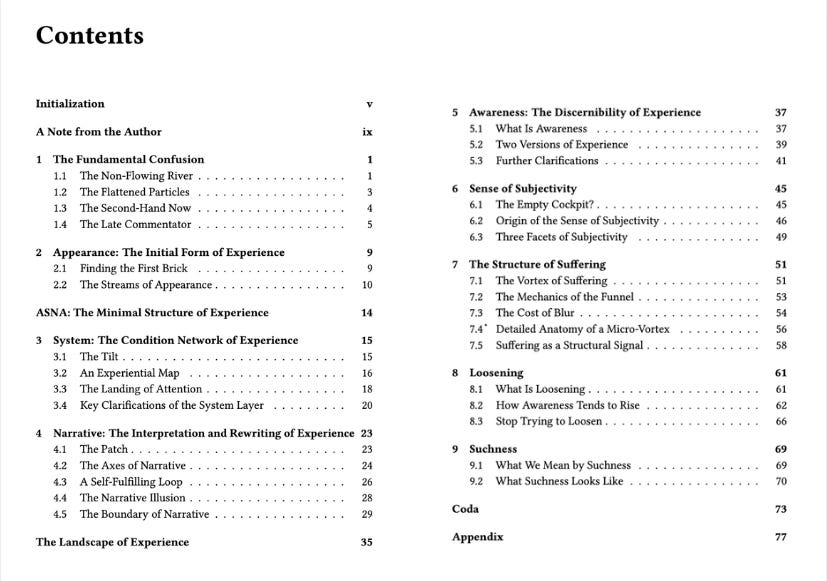
The rest of the framework and experiments are in the full book.
I’ll also publish new teardowns and drills here as supplemental material as I build them (no fixed schedule).