
Imagine a familiar scene: you’ve just come out of an intense stretch at work, or finally walked away from a culture that had been grinding you down. A well-meaning friend says,
“Maybe this is a good time to take some time off and figure out how to move your life forward.”
It sounds supportive, even compassionate. But…
The Anxiety Carried by Language
In 2023, a study found that 36% of senior tech leaders surveyed were taking antidepressants. In an environment of high pressure, constant comparison, and structural instability, some of the psychological toll reaches us through a medium we rarely stop to examine: language.
When you hear the phrase “take time off,” do you notice the logic built into that word, “off”? It quietly assumes that work is the default state, and everything else is a deviation from it. You are only “off” when the machine is powered down for maintenance, or when you have drifted away from the track you were supposed to stay on.
This points to a core problem in Refactoring Experience:
When you absorb a vocabulary uncritically, you are not just taking in words. You are also taking in the structure of experience built into them.
When Narrative Takes Over
In my book, I define suffering as a collapse of possibility. The trouble starts when a narrative hardens into fact and life begins to narrow around it.
Below are a few common workplace phrases worth pausing over. What makes them powerful is not just that other people say them frequently, but how easily they begin speaking inside your own head without being questioned (a sign of low awareness).
“Take time off.”
What are you taking time off from? From life? The phrase quietly treats work as the default state and everything outside work as the interruption. But that gets the hierarchy backwards: work is only one activity within life.
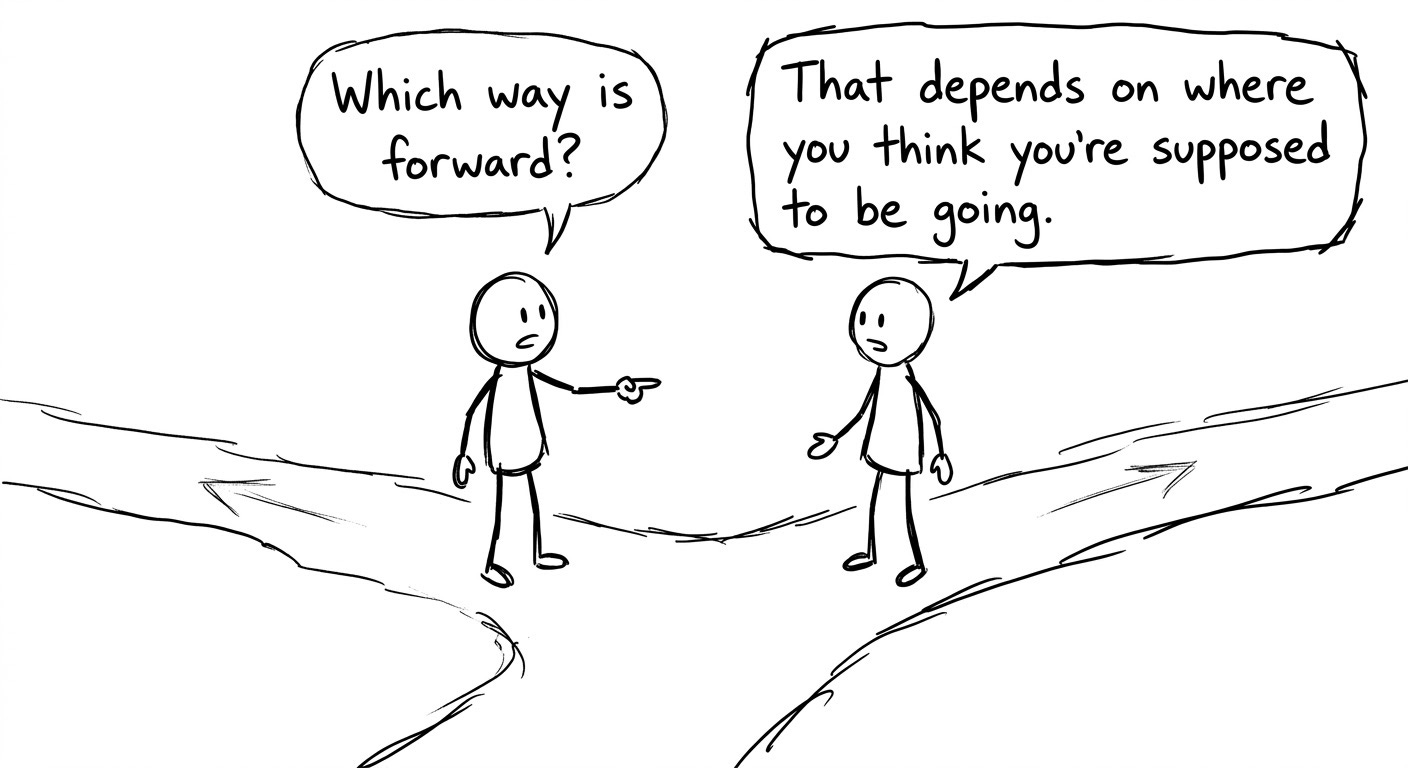
“Move life forward.”
It suggests that if your life is not moving toward recognizable milestones, then it is not moving at all. But the road is always beneath your feet; every step you take is, by definition, forward.
The deeper problem is that someone has usually already decided what counts as “forward” before you ever get to answer the question for yourself.
“Gap year.”
You leave a job, and within hours the language is already there to explain what this period is supposed to mean. The word “gap” implies that life should unfold as one seamless sequence, and that any pause is a hole that needs to be filled. But life is not inherently linear.
“The real world.”
This is not a neutral phrase. It is a way of claiming authority over the meaning of reality itself.
It suggests that idealism, artistic inquiry, or contemplative practice belong to a protected illusion, while market logic, strategic compromise, and utilitarian grind are cast as the only things serious adults should trust.
“Ownership.”
This is a remarkably effective form of psychological conditioning. It demands that you adopt the mindset of an owner, often without granting you the rights of one. It blurs contractual boundaries, inducing you to carry anxious responsibility for assets that do not belong to you.
“Wasting time.”
Ah, this phrase. This commodifies time as something that must be spent well, invested properly, or justified through output. It makes you feel that any second without visible productivity is somehow a debt to existence.
The reality? Every second of being alive, regardless of what you do, is literally a wasting of time.
As the old Chinese saying goes: “If one does not do useless things, how can one spend this limited life?”(不为无益之事,何以遣有涯之生?)
Ask Yourself
To loosen the grip of this suffering, we have to let awareness rise and put narrative back in its place. When you encounter these high-frequency workplace phrases, ask yourself two simple questions:
1. Is this describing a fact, or is it already installing a narrative?
Is it a neutral observation of what is happening, or is it already telling you what this situation is supposed to mean?
2. What is this narrative doing now that it’s in my head?
Is it helping me solve a real problem, or is it shrinking my space of experience by making me feel behind, deficient, or somehow substandard?
Most of these terms are forms of instrumental language. When you are acting as a social function—an employee, an entrepreneur, a trader—this language is efficient. But when you are trying to live as a human being (not just a role), these same words can become shackles if taken as fact.
I’ve watched this happen in my own mind too. The phrase arrives before the feeling has even had time to clarify. We must draw a line in the sand: we may operate within this language, but we must never let it become the language we use on ourselves.
Workplace language is one way narrative takes hold. Another may be even more powerful:
the absurdities that become normal simply because they are repeated often enough and left unexamined for long enough.
That is what I want to write about next.
If this resonates, I explore the larger framework behind it in my book, Refactoring Experience.
Read the first chapter:
Refactoring Experience: The Fundamental Confusion

This post is the complete first chapter of my book, Refactoring Experience: The Anatomy of Suffering and the Illusion of Self. I’m sharing it here as a self-contained introduction to the experiments and the framework.