
A Ten-Second Experiment
Select a feeling you would like to experience right now—sadness, joy, fear, irritation, or any state you assume you can summon.
There is one constraint: do not use memory, do not imagine a scenario, and do not deliberately adjust your breath or posture. Without relying on external or internal aids, see if this feeling can appear on its own within ten seconds.
You’ll find this difficult. Even if you drop the rules entirely, you cannot guarantee that a specific emotion will arrive on demand. Harder still: when an unwanted emotion arrives uninvited, can you simply command it to vanish?
If not, the statement “I control my own experience” starts to look less like a fact. On closer inspection, every key term in that sentence deserves to be re-examined.
Experience is where we start.
Welcome to Refactoring Experience.
Machines generate outputs. Humans, on the other hand, live through experience.
Experience doesn’t represent us. It constitutes us.
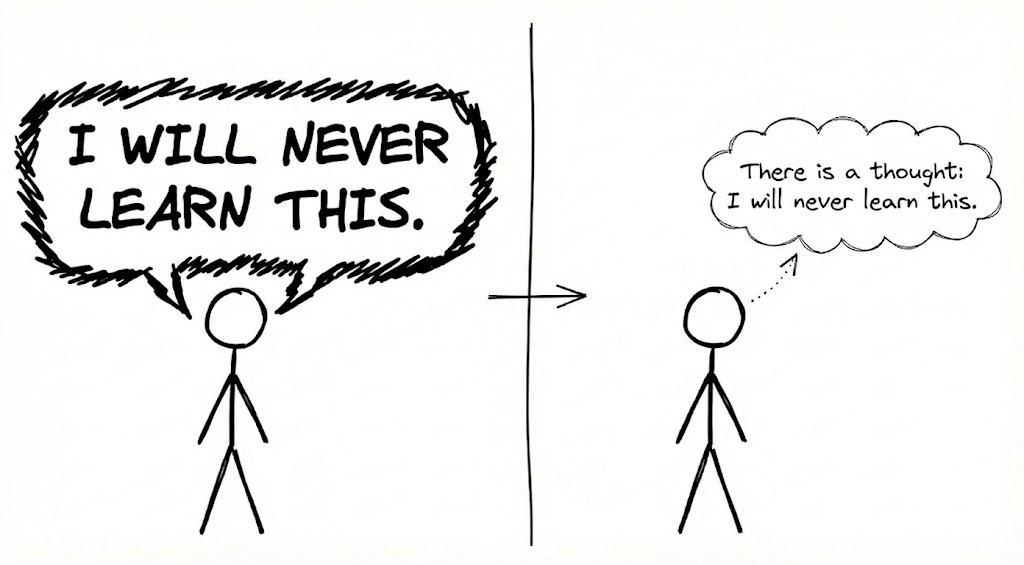
Refactoring Experience means learning to see what a moment in life is made of—before it turns into a story about “me.”
It’s a way to separate what’s happening from what you’re saying about what’s happening.
Why care?
Human suffering is a collapse of possibility in life.
It tends to happen when awareness is low and structural clarity collapses. Signals, conditions, and stories fuse into a single verdict.
Refactoring experience is about rebuilding that structural clarity. This project offers a testable framework and practical teardowns to help you do that.
I use a lens called ASNA to take these loops apart:
Appearance: Raw material of the moment. Sights, stings, and itches before they are named.
System: The internal terrain. Your fatigue, your habits, and your physiological rhythms.
Narrative: The mental script that tries to stitch everything together into a logical story.
Awareness: The degree to which experience is visible in detail, across the whole field, and as distinguishable layers.
Who am I & The Approach
I’m a contemplative practitioner living in the Bay Area. My cultural background is Buddhist and Daoist.
I sometimes draw from those traditions because they offer unusually systematic ways to examine the illusion of self, the mechanics of suffering, and practices that increase structural clarity in lived experience.
I’m not trying to be a doctrine translator. What I’m trying to express is how the “self” gets assembled and how suffering can be reduced in real life, written in modern language that is precise, verifiable, and practically meaningful.
Everything I share here comes from what I’ve actually done: meditation, standing practice, reading, and repeated observation in ordinary life. If a claim can’t be tested in direct experience, I treat it as provisional.
What you’ll find here
Most newsletters are content. This one is tools.
If you subscribe, you’ll get:
(Free) the first chapter of
Refactoring Experience — The Anatomy of Suffering and the Illusion of Self
Field notes that summarize the core claim, the mechanism, and the refactor
Diagrams, checklists, and small drills for stuck days and looping nights
An Awareness track: clarity practices drawn from Buddhism and Daoism, explained in operational, non-mystical terms
No fixed schedule. No hype.
— E. Lumen